Why AI Output Drifts Off-Brand at Scale
AI models forget brand context between sessions, forcing teams to rebuild decisions they just made.

You can approve every prompt and staff every review, but your brand voice can still fray across a month of AI-generated content. This article argues that the drift is structural: brand context was built for humans reviewing finished work, not for machines generating it continuously, and that mismatch produces off-brand output even when nobody breaks a rule. The pattern is familiar to anyone running content operations at volume: each individual output looks fine on its own, a headline here, a product description there, yet the body of work across a quarter reads like it came from three different companies. Content production requirements have roughly doubled over the past two years, and teams that lean on AI are pulling further ahead of those still working by hand, widening the gap between what gets generated and what governance can actually catch.
How statelessness makes every AI generation start from zero
The first mechanism sits inside the generation tools themselves. Most AI systems used for content and image production have no memory of the brand decisions that shaped the last output, so each new session starts cold, and the context that made the previous result work is gone. Foundation models are trained to produce the most plausible output given the prompt in front of them right now, not to stay faithful to a brand's accumulated decisions over time, which is simply how they are built, across every vendor's model.
Plausibility and brand accuracy are not the same target, and a model has no way to tell them apart. A headline can read as polished, well-structured, and entirely convincing as a piece of writing while still sounding nothing like the brand that commissioned it. The model is succeeding at a different job than the one the marketing team assumes it's doing.
That gap appears in how teams actually work. A designer can spend an afternoon coaxing a model toward the right look, through a reference image, a round of feedback, a specific crop that finally reads as on-brand. The moment that session ends, the win evaporates. The model didn't store the reference, the feedback, or the crop preference anywhere it can retrieve next time. Getting a good result once says nothing about getting it twice.
At low volume, a skilled operator can paper over this by hand, re-feeding the same context into every new session and treating the repetition as part of the job. At scale, that manual re-injection becomes the production bottleneck itself: the time spent re-establishing context for the hundredth time this month is time not spent making anything new.
How prompt fragmentation quietly erodes brand voice across teams
The second mechanism lives at the team level, compounding the first. Even when a team writes brand voice into its prompts on purpose, those prompts don't stay as stable documents that sit untouched in a shared folder. They drift, they fork, they diverge, and often nobody ever decided to change what the brand sounds like.
The pattern tends to look the same across organizations. A freelancer tweaks a prompt to get a faster result on deadline. A junior strategist "improves" the wording a week later because it reads more naturally to them. Someone else moves the updated version into a different tool, because that is where the next campaign runs. Each edit makes sense in isolation. Nobody checks any of them against the brand standard, because no single person owns that check.
One retail brand's experience makes the pattern concrete. A tone of voice had been formally banned from that brand's guidelines two quarters earlier, flagged as off-brand and retired. It resurfaced anyway, through AI-generated product descriptions built on a prompt nobody had updated to reflect the change. Nobody decided to bring the banned tone back. A prompt simply never got told it was gone.
A second layer makes this harder to catch than ordinary human error. Model providers update their systems regularly, and those updates can shift how an unchanged prompt gets interpreted, even when not a single word in the prompt itself has been edited. A prompt library that shows zero changes in its edit history can still produce measurably different output after a provider pushes an update behind the scenes. That's the most dangerous version of this drift, because the log that teams check for accountability shows nothing wrong, so nothing ever triggers a review.
Multiplying this across several brands, a full calendar of campaigns, and however many AI platforms a team touches in a month turns drift from a manageable risk into something else. It becomes close to a mathematical certainty.
Why Brand Guidelines Were Never Designed for Machines
Both mechanisms produce a deeper architectural problem: guidelines built for human review, not machine execution. Brand guidelines, as most organizations have built them, describe intent for a human reader to interpret. They are not written as executable rules a machine can apply, and that distinction decides whether an AI agent can follow them at all, not just how well.
A phrase like "conversational, with clear authority" works reasonably well in a brand book read by a trained copywriter who has absorbed years of context about what the brand actually sounds like. The same phrase means something different to a designer, a copywriter, and an AI model generating product variants for a different market, because none of them share the same implicit reference points, and the phrase itself resolves none of the ambiguity. Guidelines describe what the brand wants to feel like. They say nothing about what to do at the actual point of execution, which is exactly where an AI model is operating every time it generates something.
At low volume, experienced staff carry the missing context informally. They have absorbed years of institutional judgment about what counts as on-brand, so they fill the gaps the guidelines leave open without even noticing they are doing it. At scale, that informal knowledge lives in people who are nowhere near most of the content actually being produced. An AI agent generating the two-hundredth product description of the week has no access to the judgment that lived in a veteran copywriter's head.
What an AI agent needs looks nothing like what a brand book provides. It needs design tokens, not color swatches described in a sentence. It needs component libraries, not screenshots of approved layouts pasted into a slide deck. It needs structured content models, not a Word document that just narrates how the brand should sound. It needs explicit, quantified rules, exact hex values at defined proportions, rather than aspirational language like "vibrant but restrained." It needs metadata and taxonomy that a system can query, not a loose folder of files named however the last person who saved them felt like naming them.
Every tool in a marketing stack encodes brand intent its own way, and few of those tools talk to one another. The practical result is that the same brand ends up existing as dozens of slightly different versions scattered across tools, agencies, and regions, each one drifting a little further from the original with every update nobody synchronized.
How Three Mechanisms Compound Into a Parallel Correction Workflow
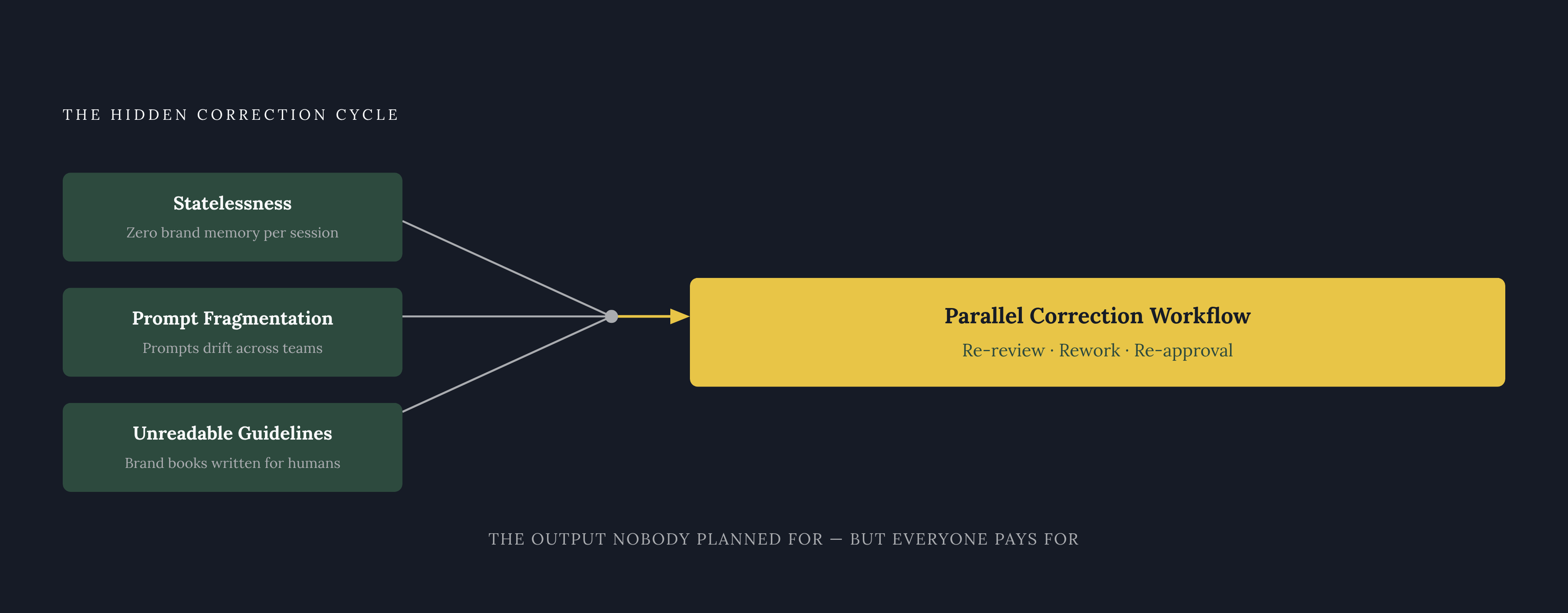
Running simultaneously, these three mechanisms don't just produce occasional quality slips. They build a second production workflow that runs alongside the first, invisible on any org chart but very real in how time actually gets spent. Organizations without governance built into the generation process spend a disproportionate share of their production time on re-review and rework. The AI speeds up the first half of the process while the correction cycle quietly eats the time that speed was supposed to free up.
Reviewing at the end of the line is structurally too late to catch most of this. Issues introduced upstream, during briefing, during templating, during the generation step itself, tend to go unnoticed until a campaign has already absorbed real design time, copy revisions, and internal sign-off. By the time anyone notices the tone is wrong or the color is off by a shade, the cost of fixing it is already larger than it looked when the problem was small enough to miss.
The risk doesn't stop at internal rework. Audiences are increasingly able to recognize generic AI output as its own category, distinct from content that carries a brand's actual voice, and they treat that category as less credible on sight. A brand that lets drift accumulate spends more on corrections and trains its own audience to discount what it publishes.
The reason this cost stays hidden for so long is simple: teams measure how fast they can generate content, not how much time the correction cycle quietly consumes behind it. That measurement gap is what makes the fix a question of timing, not effort. Catching drift after generation will always cost you more than stopping it before generation happens.
Moving Governance Upstream as the Structural Fix
Brand consistency, understood this way, is a memory problem. The organization usually already knows what its brand sounds like and looks like. What it lacks is a way to make that knowledge present at the moment a model is generating something. When that memory lives outside the generation process, in a PDF nobody consults mid-task, inconsistency gets corrected after the fact, assuming anyone catches it. When that memory lives inside the generation process, inconsistency is far less likely to appear.
That requires governance to move from a single checkpoint at the end of a workflow to every stage of it: present at briefing, present at creation, present at adaptation and publishing, with approvals routed according to actual risk.
Three connected systems make that architecture possible. The first is a centralized, machine-readable brand source of truth, not a static PDF but a living system holding voice, visual identity, messaging frameworks, and compliance rules in formats that tools and AI agents can query directly while they work. The second is prompt versioning treated as real infrastructure: canonical prompt libraries with version numbers, change logs that record who changed what, output sampling at each version, and the ability to roll back a version that turns out to produce worse results, the same discipline software engineering teams have applied to code for decades. The third is a feedback loop that lets the system learn from how content actually performs, because a governance layer that never updates based on performance data will keep enforcing rules that were correct two years ago while missing the signals that would make tomorrow's content work better.
For visual brand work, this means a model can apply every brand attribute as a precise constraint, so a human no longer has to interpret it as an aspirational description. "Vibrant but restrained" becomes a specific saturation range and a specific proportion of a palette. That translation is what makes the rule usable by a machine instead of only legible to a human reading it after the fact.
The Shared, Versioned Brand Context Layer in an AI-Native Workflow
The standard taking shape for connecting AI agents to structured external knowledge, including brand context, is MCP, the Model Context Protocol, an open standard introduced by Anthropic in November 2024. MCP gives an AI agent a consistent way to retrieve the current, correct version of a brand's rules at the moment it needs them, rather than guessing based on whatever the model absorbed during training.
MCP's role deserves to be understood accurately: it's plumbing, not strategy. It connects an agent to an organization's actual style guide, its approved asset libraries, its campaign history, but it doesn't decide what the brand voice should be or orchestrate consistency across a content calendar by itself. What it enables is an agent that references the real style guide instead of a training-data approximation of similar brands, that can query past campaign performance, and that pulls assets from an approved library rather than inventing something plausible-looking from scratch.
Bloom is built around exactly this architecture. It ingests a brand's existing assets, starting from a website, social media, or files, and turns them into structured, shared brand context that AI agents, products, and workflows can actually consume through an API or through MCP. Bloom calls the result a Brand Skill: a versioned, retrievable representation of a brand's aesthetics, voice, references, and assets that any connected agent or product can draw on, so that every AI touchpoint across an organization works from the same context instead of each tool holding its own isolated, slowly diverging copy.
Teams managing multiple brands, or agencies managing brands for several clients at once, can hold all of them in a single workspace. When a brand's logo, palette, voice, or guidance changes, connected systems retrieve the updated Brand Skill the next time they need it, a pull model rather than an automatic push to every tool at once, but one that still means every downstream system is working from the current version rather than a stale one someone forgot to update.
This structure answers all three mechanisms described earlier. Statelessness is addressed because the agent retrieves current brand context at the moment of generation. Prompt fragmentation is addressed because brand context lives in one canonical, shared place, not scattered across personal notes apps and half-remembered Slack threads. The machine-readability gap is addressed because brand rules are structured from the start for an agent to query, not written as prose for a human to interpret under deadline pressure.
The objection worth taking seriously: do pre-embedded rules calcify brands
The strongest argument against moving governance upstream is that baking rules into a system before generation happens risks freezing a brand in place. Systems built to enforce rules can end up enforcing yesterday's rules indefinitely, producing a kind of compliance theater where every output technically passes review while a campaign that should have evolved never gets the chance to.
That concern is legitimate and points to a real design requirement. A brand context layer has to be versioned and updatable by design, not static. Treated this way, a versioned brand context layer is the mechanism that makes evolution deliberate and visible.
The failure mode runs in the opposite direction from what the objection assumes. Static standards decay on their own. A governance layer that never incorporates performance data will keep enforcing rules that were correct two years ago, long after the market, the audience, or the product has moved on, and it will miss exactly the signals that would show which parts of the brand are working today. So build living, updatable brand infrastructure, and keep governance inside the generation process.
The practical resolution treats brand context the way a software team treats a codebase: updated on an intentional cadence, with every change tracked and attributed, never left to drift through ad-hoc edits and never locked permanently in place. If a brand wants to stay recognizable while it grows, it needs that same discipline, applied consistently, where its content actually gets made.