Brand Consistency Audit for AI-Native Teams
Models need machine-readable brand rules, not PDFs, to stay on-brand at scale.

Brand consistency fails at AI scale for a structural reason, not a human one: brand identity lives in documents written for people to read, while the agents producing content run on context built for machines to parse. A PDF of brand guidelines can sit in a shared drive, but it means nothing when a model generates a hundred social posts an hour. The old system of brand control worked because it was slow by design. A small team wrote the copy, approved the visuals, and kept everything on-brand simply because so few hands touched the output. AI agents remove that bottleneck, and the removal cuts both ways: production goes up, and so does the chance that nobody is checking any of it against a shared standard.
The failure modes that follow are predictable, and they compound. Left without firm constraints, models default toward the same generic, slightly breathless marketing tone, regardless of what any individual brand is supposed to sound like. Volume makes the problem worse rather than better: when AI generates content fast enough, no person reviews all of it before it ships, so drift accumulates quietly until someone notices the brand doesn't sound like itself anymore. Every handoff between tools (a brief in one document, visuals built in a design app, drafts pulled from a separate AI tool, scheduling handled somewhere else entirely) opens another point where context gets lost, especially when the person publishing the final piece never saw the original brief.
By 2026, AI agents generated thousands of brand touchpoints a day across large organizations, so consistency was no longer a design concern but a governance one. Data leakage, voice drift, regulatory exposure, and where a given asset came from now sit on the risk register next to budget and headcount. Manual approval can't keep pace with that volume. Marketing teams produce content faster than any brand manager can review it, so the queue backs up, deadlines force reviewers to skim instead of check, and off-brand material ships anyway. Different reviewers also apply the same written guidelines differently, so even the review step that does happen isn't consistent from one person to the next.
Brand consistency audits for AI-native teams versus traditional teams
A traditional brand audit asks a simple question: does the content that already shipped match the brand guide? That question works when a small team produces a manageable volume of assets and a reviewer can look at each one. For a team where AI agents generate content at scale, the audit has to ask something earlier and harder: can every agent and every tool that touches the brand read and act on brand context before it generates anything. That's the shift from a creative review to an infrastructure diagnostic. The object being audited is no longer a finished asset but the plumbing that produced it.
The reason for the shift is timing. Catching drift after a thousand assets have published is too late to matter, so the audit has to move upstream, into the systems that generate content. An AI-native audit covers four layers that a traditional audit has no reason to check. You need to ask whether brand identity exists as structured, machine-readable data, or as prose a human has to interpret. It asks whether that context is actually shared across every agent and tool that touches the brand, or whether each one is working from its own separate, possibly outdated copy. It asks whether the context is versioned, so when you update a single source, the change propagates automatically to every connected system instead of needing someone to update five different tools by hand. And you need to ask whether you can measure and check brand compliance automatically, rather than relying on one person's subjective sense of whether something looks right. Each of these layers gets its own diagnostic treatment in turn, because each one fails in a different way and needs a different fix.
How to audit whether your brand guidelines are machine-readable
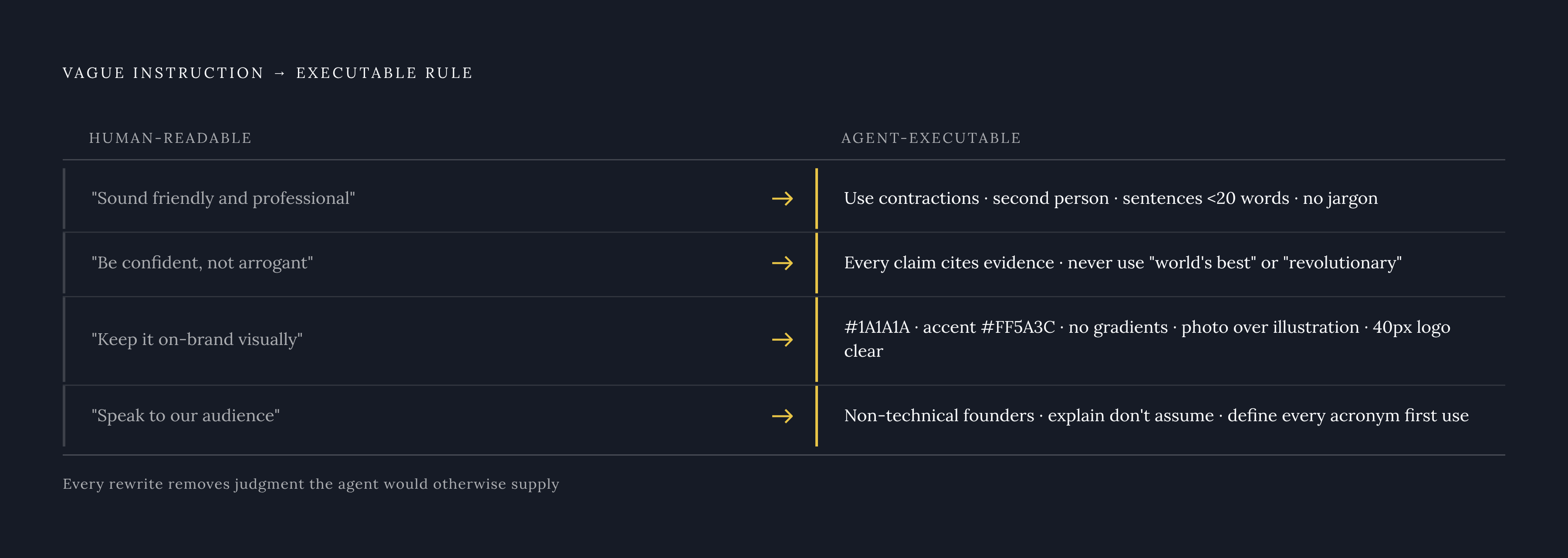
The first layer to check is whether brand guidelines are written as rules an AI agent can actually follow, or as language that only makes sense to a person who already understands the brand. An instruction like "sound friendly and professional" asks a human reader to supply judgment the sentence itself doesn't contain. A useful test: could someone brand new, or a language model with no other context, follow the rule without needing to ask a follow-up question? If the answer is no, the rule isn't specific enough to survive contact with an agent generating content on its own.
The gap between vague and workable guidance is visible once you line examples up side by side. "Sound friendly and professional" becomes something an agent can act on only once it's rewritten as: use contractions, write in second person, keep sentences short, cut jargon and buzzwords. "Be confident, not arrogant" turns into a concrete constraint once it reads: back every claim with evidence, and never use phrases like "world's best" or "revolutionary." "Keep it on-brand visually" means nothing to an image model until it specifies a primary color (say, #1A1A1A), an accent color (#FF5A3C), a ban on gradients, a preference for photography over illustration, and a minimum logo clear space of 40 pixels. "Speak to our audience" only works as an instruction once the audience is named: non-technical founders, in this case, which tells an agent to explain rather than assume, and to define any acronym the first time it appears.
A genuinely machine-readable brand schema does more than set behavioral rules like these. It attaches structured fields to each rule, along with confidence scores, a record of where the rule came from, and a timestamp showing when it was last updated, so that any agent querying the schema knows not just what the rule says but how current and authoritative it is. One emerging effort in this space, brand.context, was published in April 2026 as AIVO Evidentia Working Paper WP-2026-04. It's a machine-readable brand context standard built for AI agents to consume, and it translates evidence-grade filter types into a structured JSON-LD schema that a brand publishes at a predictable web location on its own domain, so you can use it as a benchmark to audit an existing setup against.
The practical questions for this layer come down to a short list: are voice rules written as constraints a language model can enforce, or as adjectives that require a human to interpret them? Are visual rules expressed as specific values, hex codes, pixel measurements, required file formats, rather than descriptive phrases like "clean" or "modern"? Does the brand documentation carry a timestamp and a version number, so an agent working from it knows whether the context is current? And is that documentation structured as actual data, something queryable through JSON-LD, a schema, or an API, or is it still sitting as prose inside a PDF that only a person can read?
Auditing whether brand context is shared or siloed across tools and agents
The second layer to check is whether every agent and tool touching the brand draws from one shared source of context, because separate, inconsistent copies of that context are the main way drift spreads once AI is producing at volume. The pattern is familiar to anyone who has worked across more than two or three tools: the brief sits in one document, the visual assets live in a design app, AI drafts get pulled from a separate generation tool, and scheduling happens somewhere else again. Each of those systems carries its own partial version of what the brand is supposed to sound and look like, and every handoff between them is a point where that version can drift from the others.
The Model Context Protocol, or MCP, is the infrastructure layer built to close that gap. It lets an AI agent query actual brand data before generating anything, checking a style guide, referencing a past campaign, pulling an approved image from an asset library, so the output is grounded in specific, current context instead of whatever generic pattern the model learned during training. Without MCP, integration complexity rises quadratically as more AI agents spread through an organization, while with MCP in place, it rises linearly instead. For a marketing operations team running ten or more connected tools, that difference separates an integration workload that stays manageable from one that grows faster than the team can keep up with.
The audit questions here are concrete. Does each AI tool in use pull brand context from the same underlying source, or does each one keep its own copy that can quietly fall out of sync with the others? When brand guidelines change, does the update reach every connected agent and tool automatically, or do you have to go update each system by hand? Are the brand context sources reachable through an API or through MCP, or only through documents meant for a person to open and read? And do agents working inside Claude, Cursor, ChatGPT, or other MCP-compatible environments all draw on the same brand context, or does each environment end up holding a separate version that can diverge from the rest? One example of the architecture this layer is checking for comes from Bloom, which structures brand identity as a versioned Brand Skill: a shared source of brand context, retrievable by API and by MCP, that any connected agent or product can pull from and apply. Opening brand context to a wider set of agents and tools means thinking through who can query that data and what they're allowed to do with it, not just whether the connection works technically.
Auditing brand consistency across AI-generated images, copy, and video
Brand drift appears differently depending on the medium, so a generic consistency test applied across images, copy, and video misses how each one actually breaks.
Copy fails first through sheer variation: every team member prompting a model differently produces the same brand speaking in several different voices at once, and the model's own default tone, generic and a little breathless, bleeds in wherever a specific constraint is missing. The useful check is whether the voice constraints are specific enough to actually rule out that default AI tone: banned words, required sentence structures, a defined audience, rather than just a description of the tone a team is hoping for.
Images fail differently. Left to its own devices, an AI image tool invents its own colors, lighting, and style, and off-palette, off-brand images pile up faster than any human reviewer can catch them one by one. Training an image model on a curated set of brand-specific examples, covering color, lighting, texture, and composition, teaches it those patterns well enough to apply them automatically to new generations, and the quality of those training examples determines how well the patterns transfer, more than the quantity of examples does. One way to see automated visual compliance working in practice: a review pipeline built on Gemini's multimodal abilities can flag a specific violation, such as a green that renders as #1A5238 instead of the brand's required #184F35, and then automatically adjust the generation prompt based on that exact finding. The audit questions that matter here: are image tools trained on or constrained by actual brand visual assets, or working from text prompts alone with no reference material behind them? And does the team have any automated check on color, logo placement, and composition before an asset reaches a human reviewer, or is all of that compliance work still done by eye?
Video is the newest and least settled of the three. Character-consistent AI video moved from an impressive demo to an achievable goal for professional work in 2026, but you still need a deliberately reference-driven workflow to get there, and holding that consistency over any real length of footage remains a limitation most tools haven't solved. Most AI video tools in 2026 still struggle to stay coherent much past 30 to 60 seconds. The audit questions for this modality follow from that limitation directly: does the team have explicit brand standards for AI video, covering character consistency, color grading, and motion style, or are video outputs judged only by general creative instinct? And is there a defined approval step built specifically for AI video's particular failure modes, separate from how copy and images get reviewed?
Auditing brand context management for agencies and multi-brand teams
Agencies and teams running multiple brands face a multiplied version of the silo problem that single brands face. Without a workspace that treats each brand's context as its own distinct, governed set of data, agents and tools start collapsing separate brand identities into each other once volume picks up. The specific risk: when several brands run out of one shared workspace, context from one client bleeds into output meant for another, especially where agents pull from a shared prompt history or from one unstructured guidelines document built without any separation between brands.
For this layer, the diagnostic questions apply the same shape used for the single-brand layers above, this time per brand across an entire account list. Is each brand's context stored and versioned as its own separate entity, with its own schema, its own voice rules, its own visual constraints, rather than as one shared file with notes distinguishing which parts apply to which client? When an agent generates content for one brand, is there a hard boundary preventing it from drawing on another brand's prompt history, reference images, or past campaigns, or does the workspace leave that separation to chance? And when a client updates their guidelines, does that update reach only the systems and agents working on that one brand, or does it risk touching work being done for someone else? For a team managing a dozen brands across multiple AI tools, the answers to these questions decide whether multi-brand work scales cleanly or starts quietly contaminating itself from one account to the next.