Signals That Tell You AI Output Is Drifting Before Readers Notice
Fixed baselines and repeat tests expose off-brand AI drift early.

Detecting when AI output drifts off-brand before readers notice requires comparing repeated outputs against fixed brand baselines. The earliest signals appear in copy tone, visual choices, and structural changes in system behavior. Teams can use those signals to keep drift in check when they measure them the same way each time and give agents shared, machine-readable brand context.
Why AI output drifts without anyone deciding to change anything
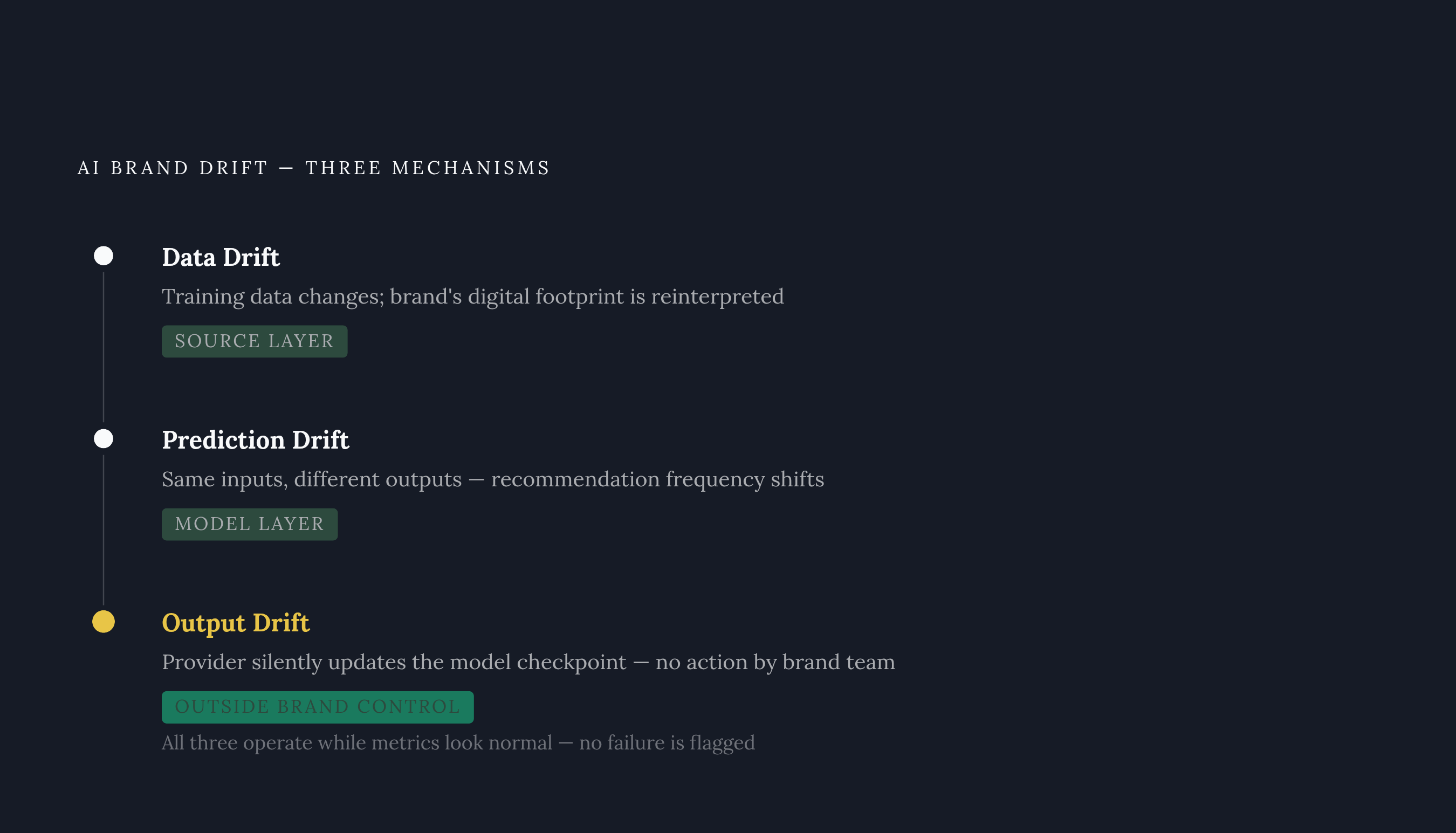
AI brand drift differs from ordinary inconsistency because it can emerge from systems operating exactly as intended. No creative decision needs to change. Instead, routine operations gradually alter how the system represents the brand, without producing the kind of discrete failure that a conventional dashboard would flag.
Three mechanisms explain how this happens. Data drift changes the model’s picture of a brand as training data changes, information is reweighted, or the brand’s digital footprint is reinterpreted. Prediction drift produces different outputs from the same inputs, including changes in how often a brand appears in recommendations. Output drift occurs when a hosted provider updates its underlying model checkpoint, changing response characteristics without any change on the brand’s side.
The difficulty is that brand identity and measured performance can move in different directions. Content can still hit its operational targets while losing what makes the brand stand out. Consumer perception surveys may therefore reveal divergence that internal monitoring missed. The system is working, the numbers look fine, and the brand is moving.
How the signals appear in copy before readers consciously register the shift
Copy drift often begins with subtle changes in emphasis. A brand known for speed starts to be described as reliable. Both attributes may sound favorable, but the substitution changes what readers learn to associate with the brand. Sentiment drift is therefore an early warning system.
Qualifiers provide another signal. Phrases such as “good but expensive” or “popular, though some users report” introduce reservations that were absent from earlier outputs. Comparison framing can shift too, with different competitors entering the answer or the brand moving from the reference point to an alternative. Together, these changes show that the brand is being repositioned before a drop in visibility makes it clear.
External content can drive that repositioning without an internal failure. An unnamed email marketing platform saw its AI mention rate fall measurably over three weeks, with drift detection correlating the decline with a competitor publishing dozens of comprehensive comparison guides. The competitor had changed its AI-visible content while its product remained unchanged. By May 2026, the lag between negative press and output changes on major engines had compressed to hours, leaving weekly audits too slow for some intervention windows.
The visual signals that show up in generated creative before anyone flags a brief
Visual drift can preserve an asset’s structure while changing its character. The CLIP text encoder translates prompt language into coordinates used by the image generator. When its weights change, identical words can map to different coordinates. A frozen prompt is therefore not a frozen visual instruction.
The drift is uneven across word categories. Structural nouns such as “packaging” and “logo” change less than qualitative adjectives such as “vibrant” and “minimal.” Layout can remain recognizable while color, finish, and mood shift. This helps explain how an asset can pass review even as it moves away from the brand.
The Acme Corp worked case illustrates the distinction. After the SD 4.0 update silently swapped the encoder’s projection head, Delta-E color-distance measurements showed that one brand color had drifted by nearly double the average measured across forty brand kits. The prompt and seed had not changed. The variation came from the system interpreting them.
Other signals are desaturated colors, rendering that looks warmer or cooler, and a visual style that starts to look more like newer training data. Typography and spacing can also drift when coding agents use interpolated approximations of actual design-system tokens. Fine-tuning is not complete protection either, because adapters trained on an older encoder geometry can apply their corrections to the wrong coordinates after an update.
Structural output signals that indicate the system itself has shifted
Changes in how the system runs can show drift before a content review does. Parse failures, latency changes, and rising override rates are relevant brand signals when they accompany changing output behavior. They are not proof in isolation. Their value lies in showing where the system may have changed.
Latency, token use, and verbosity increasing together suggest a shift toward longer completions, potentially following a model checkpoint change. When production triples while approver capacity stays flat, approval becomes a spot check, better suited to catching obvious failures than gradual divergence.
Team knowledge provides another immediate diagnostic. Asking three people to describe the house style in one sentence can expose conflicting instructions that also reach the model. In multi-agent chains, those inconsistencies can grow as text passes between sub-agents without strict rules for style and facts, and spread from one asset across a portfolio.
Deloitte found that only a small minority of organizations have mature governance capabilities for autonomous AI risks. A warning cannot protect the brand when no one owns the task of interpreting it.
What drift costs when it compounds undetected
Undetected drift produces work that can clear review while underperforming in market. Acceptable-looking assets gradually weaken creative effectiveness and brand equity, without supplying an obvious moment at which to intervene.
Adam Peruta of Syracuse University’s Newhouse School reported research in Harvard Business Review in September 2026 showing that consumers could not reliably distinguish AI-generated from human-made video ads from major brands. Yet the AI ads had lower scores for short-term sales potential and long-term brand equity.
IAB data accessed in October 2026 showed that most of the advertising executives surveyed said they had at least one AI incident with off-brand content. A substantial share had to pause or pull ads. These findings establish two distinct costs, namely quiet underperformance and visible intervention after publication. Detection needs to address both, rather than treating approval as evidence that the system remains aligned.
How to detect when AI output drifts off-brand through repeatable testing
To check for drift, teams can start with a fixed prompt set. It should cover direct brand questions, category recommendations, problem-solution queries, comparisons, and buying-intent questions for specific use cases. Each category tests a different way that readers come across the brand. The wording must remain fixed between runs so that query changes do not masquerade as output drift.
Language models can give different answers to the same question even when the model has had no meaningful change. A single unusual answer is insufficient evidence. A change should count as drift only when it persists across repeated runs and multiple prompts.
At scale, aspect-based sentiment analysis, or ABSA, can distinguish changes in specific attributes rather than reducing every answer to positive or negative. A conceptual pipeline begins by probing models with controlled prompt permutations and varied temperatures. It then analyzes attribute-level sentiment, correlates changes with external media signals, and alerts on rate-of-change thresholds alongside absolute scores. The monitoring set still needs to stay the same from one comparison run to the next.
Human feedback complements those measurements. Reviewer confidence scores, thumbs-up or thumbs-down feedback, error categories, support tickets, and examples of newly recurring failures add context that automated scoring may miss. Together, they turn an impression of changing tone into a record that can be investigated.
Detecting visual drift before the brief gets blamed
Visual detection needs a versioned embedding store. The baseline should preserve the embedding vectors associated with approved brand assets and the prompts that produced them. This gives the team a reference below the wording of the brief. Prompt-lock alone cannot provide that reference after an encoder update.
When the encoder changes, the workflow is to rerun the same prompts and compare the results with stored baselines. Delta-E measures color distance, while cosine similarity measures movement between embedding vectors. A threshold breach becomes the detection event. This separates a measurable change from an unstructured debate about whether an image feels right.
Correct logo placement and layout do not rule out drift in color temperature, finish, or visual character. Prompt templates should therefore be versioned against a specific encoder, with provider updates triggering revalidation before reviewer complaints.
Where supported, embedding inversion offers a correction path. Recovering the original embedding vector and feeding it directly to the decoder can restore color fidelity without repeated prompt revisions. The documented approach takes minutes rather than the hours otherwise spent adjusting language.
Why brand context in a PDF or a prompt doesn't hold under agentic volume
Detection exposes a change after it has occurred. A recurring source of that change is incomplete or inconsistent brand context. A voice guide written for people does not automatically become usable instructions for an agent. Nor does a visual standard held in a senior reviewer’s memory.
A file name, upload date, and format say little about when a logo should be used. Without structured fields distinguishing primary from secondary lockups, an agent lacks the semantic information needed to choose between them. Guidelines dispersed across PDFs create a similar retrieval problem.
Organizational ambiguity then becomes model ambiguity. Conflicting descriptions of house style reach agents through prompts and retrieved documents, while multi-client teams risk collapsing distinct brands into generic instructions. Adding context by hand in each session can also lead to inconsistency because the rules can be described differently each time.
Approval cannot repair that source on its own. Correcting an asset leaves the next batch exposed when its brief, template, or constraints remain unchanged. The earlier detection methods are necessary, but they do not make missing brand context available to the system generating the work.
Making brand context machine-readable so agents have something reliable to work from
The preventive step is to turn brand identity into shared, structured, versioned context. Machine-readable guidelines set out which color values are approved, the rules for logo placement and clear space, which claims are allowed, and which phrasing is banned. They replace ambiguity with explicit constraints. Voice rules can likewise be tied to the content types they govern rather than pasted into every session as general advice.
Open specifications illustrate two approaches. The permissively licensed brand.md specification structures brand standards for AI tools to use as context. The AIVO Evidentia Working Paper WP-2026-04, published in April 2026, describes brand.context for commerce and purchase recommendations, translating eight evidence-grade filter types into a JSON-LD schema published at a predictable location on the brand’s domain. These address related but distinct uses of machine-readable brand information.
Distribution is equally important. Anthropic’s Model Context Protocol, or MCP, gives agents an interface to query actual data so they have more than general knowledge to work from. Figma made its MCP server generally available at Schema 2025, giving coding agents access to actual component names, spacing tokens, and accessibility properties.
For a brand team, the objective is one shared guide, asset library, and campaign brief available through MCP or an API. Versioned changes should propagate automatically to connected agents. Finished output can then be audited against the same structured rules used during generation, with evidence supporting a pass or fail for each check.
Turning the signals into a standing practice, not a one-time audit
Copy and recommendation monitoring needs a rerun frequency suited to the volatility of the category and media environment. Checking once a week is too slow when teams have only hours to act. Visual library monitoring, by contrast, can combine update-triggered revalidation with a consistent weekly random sample scored against written brand rules.
That sample provides a practical audit system. Compliance trends show whether outputs are moving away from the rules, while element consistency tracks changes such as how often the logo lockup is missing. Performance by element adds a different test by showing which brand elements appear in top-performing assets.
When a batch fails, the corrective work belongs upstream. The brief, prompt template, reference set, or constraint list needs attention alongside the individual asset. Ownership must also extend to the whole library and its shared context, because production volume removes the possibility of personal oversight for every output.
Pacific.ai’s 2025 AI governance survey found that roughly half of organizations check their production AI systems for accuracy, drift, and misuse. The remaining gap is not a lack of possible signals. Drift is neither inevitable nor invisible, and it announces itself through copy tone, visual embedding shifts, structural output changes, and operational gaps before audiences consciously notice. The teams that catch it are the ones that have decided to look.