Brand Voice Decay in Long-Running AI Workflows
AI models drift off-brand without machine-readable voice context built into infrastructure.
A long article can open sounding exactly like the company that wrote it. By the closing paragraph, it reads like a different company entirely: looser structure, generic transitions, the particular turns of phrase that made the opening distinctive have quietly disappeared. That drift is not a failure of the prompt or the person who wrote it. It happens because brand context was never put into a form an AI agent can actually use, so the model fills the gap with the statistical average of everything it was trained on, which is the opposite of a distinctive brand.
Brand voice decay is a structural failure, not a prompting or talent problem
This failure mode has a name: brand voice drift. The cause is almost always the same, and it repeats across companies of every size. The real voice of the brand sits in a PDF nobody opens, or in a founder's head, and nobody has ever turned it into something a machine can read and follow. An AI model cannot guess at intent when the instructions are vague or missing. It fills that space with the mean of the internet, which is precisely what a differentiated brand is trying to avoid. Brand voice consistency, understood correctly, is an operational controls problem. You can't fix data integrity just by telling engineers to be more careful, and you can't fix brand consistency just by telling writers or prompts to try harder.
How decay accelerates in long-running workflows specifically
Each AI generation call starts cold, so it has no memory of what came before it. Whatever drift creeps into one output becomes the baseline for the next, and the next after that, so the inconsistency compounds. The effect is visible inside a single long article: the opening section sounds like the brand, and by the later sections the language has slid toward something generic. That is the small-scale version of what happens to an entire content program across months of output. At volume, the same pattern multiplies across people. A sales development rep, an account executive, and someone in revenue operations might each prompt AI independently to draft outreach sequences and follow-ups, and because none of them shares a common context layer, the company's positioning fractures message by message, prospect by prospect. Agencies managing several client accounts run into the same structural problem from a different angle: without separate, clearly encoded contexts for each brand, a model can bleed one client's voice into another's work. AI-generated creative work, images, copy, video, carries its own version of this compounding failure, since most generation tools hold no memory of a brand between sessions, so small stylistic choices drift wider with each new asset until a campaign no longer reads as one brand's work. Scaling video production makes the end state obvious: when team members use different tools, different styles, and different prompts, brand identity splits apart, and audiences pick up on that inconsistency faster than most marketing teams expect. Ordinary drift turns into lasting decay when there is no feedback loop. Teams that never log brand corrections and feed them back into the system have no way to stop the error from compounding further.
What "operationalized" brand context means in practice
A brand voice guide written for people to read is not enough for an AI workflow to run on. The real fix is to rebuild that guide as a machine-readable instruction set, one an agent can use directly as a system prompt. The gap between a human-readable guide and a machine-readable one comes down to specificity. "Uses contractions, asks one rhetorical question per section, never explains basic industry terms" tells it what to do. A workable, machine-readable brand voice document needs several concrete pieces: tone descriptors tied to behavioral examples rather than adjectives; explicit sentence-structure rules covering average length, use of rhetorical devices, and how technical terms get handled; a vocabulary list of approved words, forbidden words, and forbidden patterns, such as no passive voice in calls to action or no opening a piece with "In today's digital landscape"; three to five verbatim paragraphs pulled from the brand's best-performing on-brand content; and a set of negative examples showing what the brand would never say and how it would never phrase something, since clear boundaries do more for a model than aspirational targets ever will. Once you build this document, you need to prepend it to every AI session as the master system prompt, not keep it as a reference someone checks once in a while. Voice also needs calibration by context: a technical whitepaper and a social caption can share the same underlying brand DNA while needing very different structural instructions. A tiered prompt library organized by content type works better than a single flat document, applying the master voice guide with channel-specific adjustments layered on top. McKinsey's framing of the agentic marketing shift is useful here: making that shift real requires a modernized technology foundation, including unified identity and data layers, flexible model-serving infrastructure, and content and activation systems that expose reliable APIs agents can act on. Even a well-built machine-readable guide fails at the first step past the document itself, if it lives in one person's local Notion page and has to be copy-pasted into every new session by hand.
Why a well-written brand prompt decays without persistent infrastructure
If a correctly specified, machine-readable brand voice guide has to be reintroduced by hand into every session, it still decays, because that manual step is where drift gets back in. Picture the common workaround: each team member keeps a personal copy of the brand context and pastes it in before each session, introducing small variations in how they do it every time. That setup is siloed rather than shared, and it opens the door to drift at every session boundary. Without version control, there is no inheritance either. When the brand evolves, a new product line launches, a repositioning happens, a tone shift gets approved, every individual's local copy goes stale, and nothing exists to push the update downstream automatically. At the scale of multiple agents working together, the problem becomes architectural rather than habitual: agents running multi-step workflows end to end have no shared data layer unless one gets built for them, and each agent operates from whatever happens to be in its own context window at that moment. In the current state of agentic architecture, agents carry out multi-step workflows start to finish, and keeping them consistent requires shared data and guardrails that check every output against brand, legal, and compliance standards together. Per-session prompt pasting cannot deliver that. Brand context managed through manual pasting behaves like configuration managed by word of mouth. It holds up fine until the team grows, the product changes, or someone just forgets a step. Persistent infrastructure means something specific: brand context that lives inside the workflow itself, reachable by any connected agent or tool without a person reintroducing it each time, and versioned so updates reach every downstream system automatically. Brand voice consistency is an infrastructure problem: the fix is a system where brand context exists in a form AI agents can reliably pull from. Rainbrand-Bloom's model treats brand identity as structured, versioned infrastructure that every agent and product retrieves from one source of truth, so drift has no room to compound across outputs once every downstream system inherits the same encoded context.
MCP: the infrastructure layer for persistent brand context
The Model Context Protocol, known as MCP, is the infrastructure layer that makes brand-grounded AI workflows workable at real scale, because it lets an agent query structured brand context before it generates anything, instead of depending on whatever got pasted into that one session. MCP lets the agent query a brand's own data directly, its style guide, its past campaigns, its approved asset library, so the output is grounded in something specific. Concrete examples already exist. Knak shipped an MCP server in April 2026 that connects AI assistants to a brand's campaigns and themes to generate production-ready email assets, and because that server runs through the same rendering pipeline as the visual editor, the output handles Outlook compatibility, dark mode, and responsive behavior the same way a human-built email would. Notion and Google Drive both offer MCP servers, so Claude can pull a brand voice profile, an ideal customer profile document, or a content calendar by name, and you don't need to copy information between browser tabs to rebuild context from scratch each session. For a brand team, MCP functions as the delivery mechanism for the persistent brand context layer the previous section called for: context stored once, versioned, and retrievable by any agent connected to it. None of this should be mistaken for a fully solved problem. Public benchmarks show that MCP workflows use far more tokens than command-line approaches for the same tasks, and reliability drops as tasks get harder. Building on MCP requires implementing it carefully, with the same discipline that the infrastructure argument calls for everywhere else. A formal registry of agents matters here too: documenting each agent's purpose, scope, and performance keeps the system from fragmenting, and retiring outdated or redundant agents rather than leaving them running keeps stale brand context from lingering in the pipeline.
Enterprise-scale brand infrastructure that works
Organizations that have eliminated brand voice decay at scale share one structural trait: brand context is at the infrastructure level and gets shared across every agent in the workflow, rather than being configured separately for each agent or each session. Monks, an enterprise agency, was recognized by The One Show in May 2025 with a new award category, AI Pioneer Organization, created specifically for them. Their product, Monks.Flow, deploys agents across a brand's entire marketing operation, spanning strategy, creative, delivery, and measurement. For Headspace, Monks.Flow generated 460 custom assets across 20 use cases for a single campaign, a volume achievable because brand context was shared infrastructure that every agent drew from directly. The pattern repeats across these cases in a specific way: the organizations that solved the problem did not respond by hiring more editors or demanding stricter prompts. They built or adopted a shared context layer, and every agent and every output draws from it directly. McKinsey's staged deployment model offers a useful sequencing lesson for teams who are building toward this. One consumer brand rolled out its agentic marketing system in three waves, starting with an ideation engine, then adding rapid pretesting of creative concepts alongside automatic checks of content against brand, legal, and risk standards. The order matters because governance gets built into the system from the start, not bolted on once the system is already running.
The objection that governance and review processes are sufficient
The most common response to brand voice decay is governance: tighter review checklists, tiered approval workflows, monthly audits of the prompt library. These measures do reduce drift in individual pieces of output, but they can't stop structural decay, because they treat the symptom, not the cause. Credit where it belongs: governance catches the worst deviations before anything gets published, it creates real accountability, and it improves the quality of individual outputs. Those are real gains, and no serious case against governance should pretend otherwise. Where governance runs into a hard limit is structural. Review processes are only as consistent as the people doing the reviewing, and that does not scale as a team grows or as the volume of AI-generated output increases. Prompt libraries need upkeep, and if one team member works from a cached or personal version of a prompt, the library's integrity breaks with no signal that anything went wrong. Corrections made during review are valuable data, but most teams throw that data away. The teams that log every brand correction and feed it back into the prompt library every month are doing the right thing, but the process still depends on someone remembering to do it, and the versioning problem remains unsolved. The sharper point here is that 2026 has revealed a split in outcomes: organizations with governance layers produce more consistent content than those without any governance at all, but governance alone cannot match the consistency of organizations that have embedded brand context at the infrastructure level, because governance still depends on humans doing the right thing at every single step. Readers frequently cannot tell AI-written content from human-written content in blind tests, so the risk from decay is not always visible right away. The brand equity cost accumulates quietly instead, until it appears later in a conversion problem, a trust problem with the audience, or a competitive differentiation problem the company didn't see coming. None of this means choosing governance or infrastructure as an either-or. Governance is necessary and, on its own, insufficient. Review processes belong inside the workflow as a quality signal that catches the edge cases infrastructure misses, not as the primary line of defense against decay that is structural in origin.
Building a brand agent-ready: the infrastructure build sequence
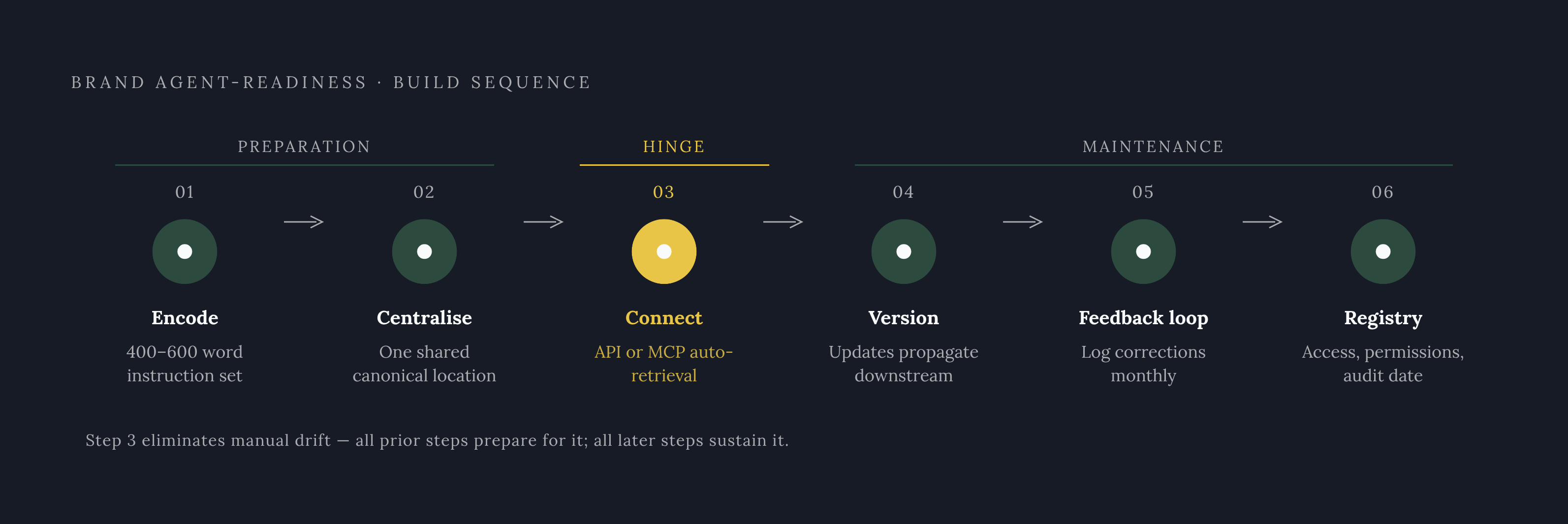
Making a brand agent-ready is a sequence to build, not a single project to finish and move past. You start by encoding brand context in a form machines can read, then you make that context persistent and shared across the organization, and you finish by versioning it so updates reach every downstream agent and output automatically. The first step is producing a machine-readable version of the brand's guidelines: a 400 to 600 word instruction set covering tone descriptors, sentence structure rules, vocabulary lists, forbidden patterns, and three to five verbatim exemplar paragraphs, built along the lines described earlier in this piece. The second step turns that document into the organization's single shared source of truth: it lives in one canonical location that every team member and every connected agent can reach, instead of scattered across individual Notion pages or local files, so teams no longer work from mismatched copies of the brand's voice. The third step is connecting that canonical context to the workflow itself through an API or through MCP, so agents can retrieve it without a human reintroducing it each time; tools such as Bloom do this by converting a brand's assets into a versioned, retrievable Brand Skill that any MCP-compatible agent or tool can pull from, meaning Claude, Cursor, ChatGPT, or any other connected environment works from the same context without anyone pasting it in by hand. The fourth step is versioning that context the way software teams version code, so that when the brand's voice evolves, every downstream system inherits the update automatically. The fifth step is building the feedback loop itself: logging every brand correction that comes out of review, checking that log monthly, and routing systematic deviations back into the brand context document, which keeps the infrastructure current on an ongoing schedule. The sixth step is keeping a formal registry of agents, recording which ones have access to the brand context, what each is permitted to generate, and when each was last audited, and retiring outdated or redundant agents rather than letting them keep running on stale context. For multi-brand operators and agencies, the same structure applies at the level of the whole workspace: each brand gets its own versioned context, managed from one place, with no bleed between clients, which makes brand management a first-class part of the workflow rather than an afterthought bolted onto the creative tools. There's also a regulatory motivator that gives this work urgency beyond brand quality alone. Starting 2 August 2026, under Article 50(4) of the EU AI Act, anyone using AI to generate images, audio, or video for professional purposes may need to label that content as AI-generated or manipulated. When teams have no audit trail distinguishing AI-generated output from human-reviewed work, they carry a regulatory exposure that persistent infrastructure, by its nature, closes.