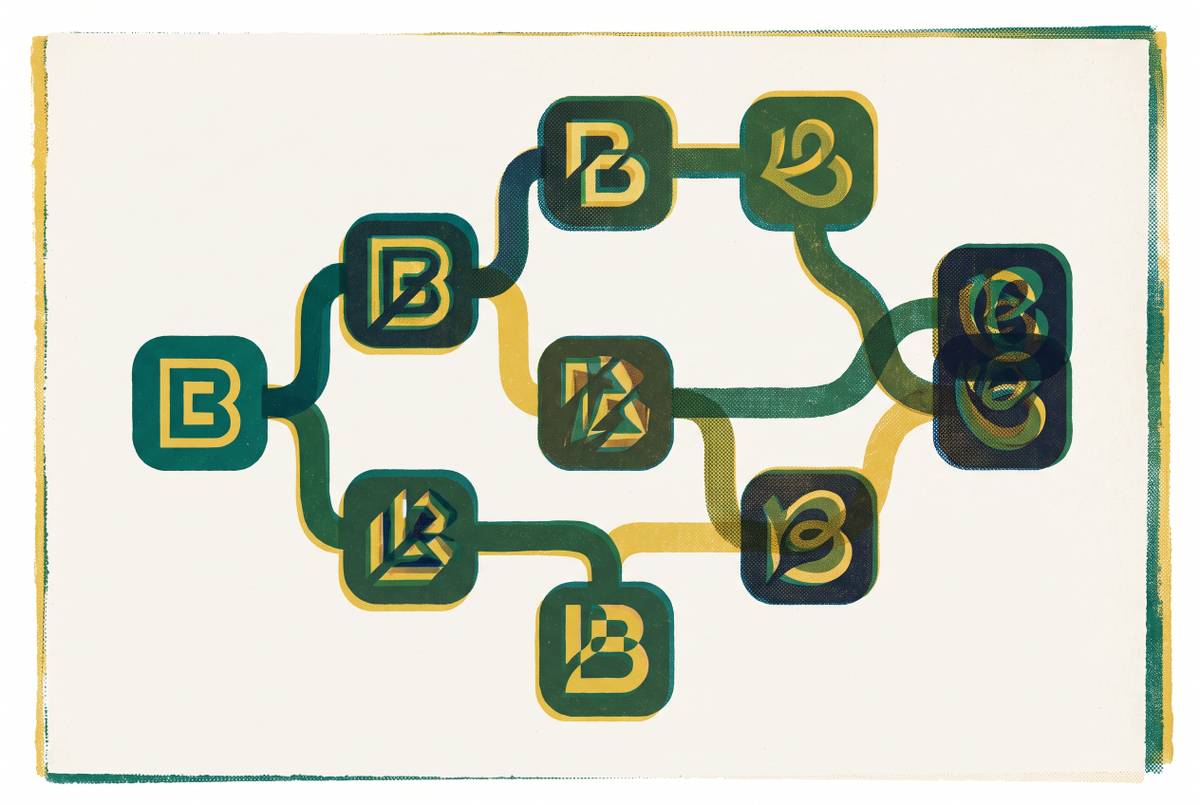
Brand Registry Architecture for Multi-Team AI Product Portfolios
Centralized brand registries give AI agents machine-readable identity rules across your portfolio.
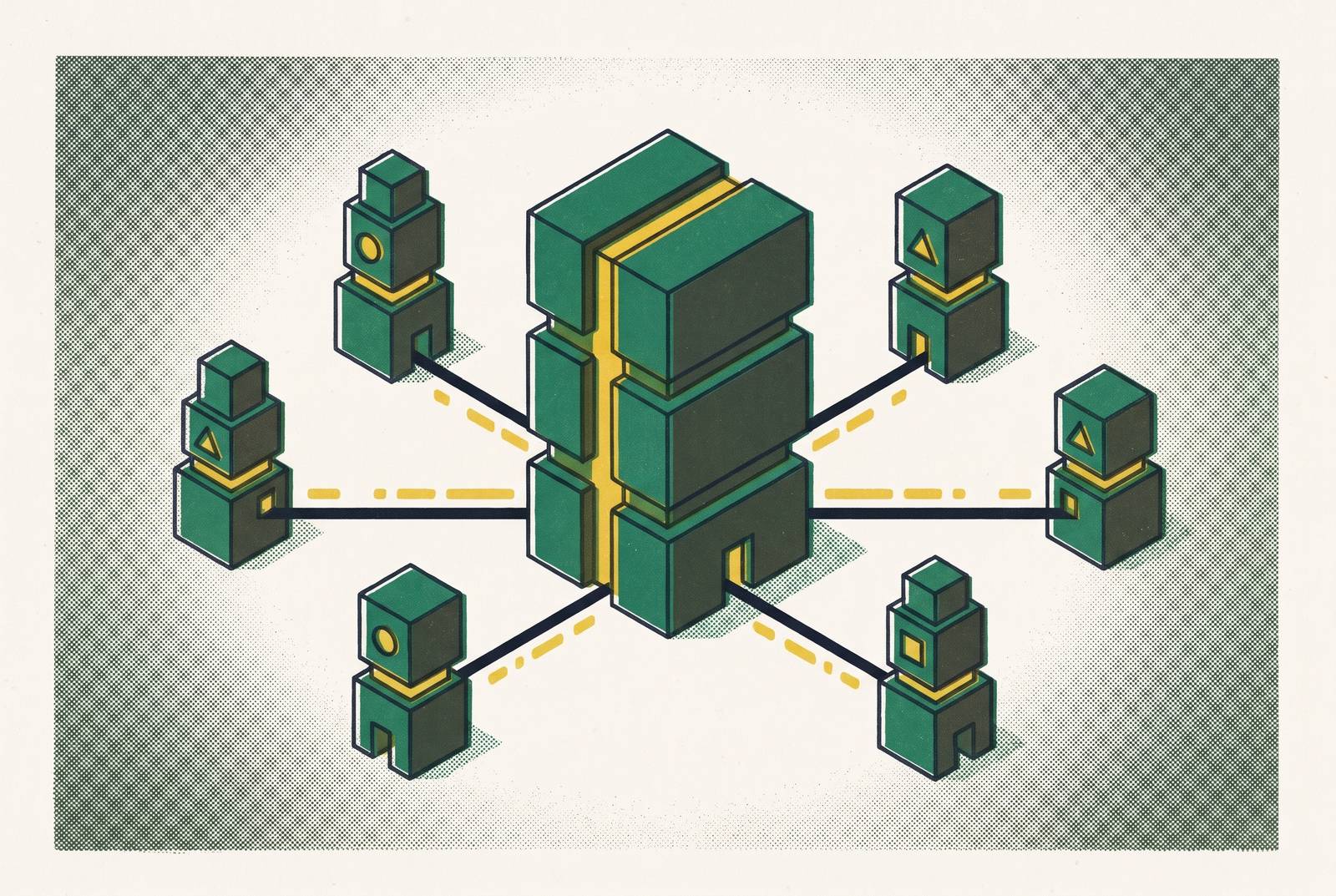
A centralized, versioned brand registry is the brand layer for agents. It gives every connected agent and product the same governed identity, the same relationships across the portfolio, and rules for each task, taking the place of separate team guidelines and constant manual prompting. For multi-team AI product portfolios, preventing agentic brand drift requires shared infrastructure.
Why portfolio-scale AI output makes siloed brand guidelines structurally inadequate
When teams use AI agents to produce work across a portfolio, brand governance becomes a matter of how the system is built as well as how work is reviewed. Traditional guidelines assumed a finite group of people producing touchpoints that manual oversight and quarterly reviews could cover. Each agent without shared context interprets voice, naming, and visual rules independently, so divergence compounds faster than reviewers can resolve it.
Agentic brand drift names this specific failure. It is a gradual, self-compounding divergence between a firm’s intended brand identity and the emergent brand character its agents produce. Because drift can co-occur with improving performance metrics, conventional monitoring does not reveal it. The root cause is not poor brand capability alone, but identity that was never made machine-readable. Adjectives such as “bold, human, trustworthy” leave agents to supply their own operating rules.
Dispersed documentation makes that interpretation harder to govern. Slack threads, Notion pages, and static PDFs provide no structured, queryable layer against which agents can reason. Shadow AI adds separate interpretations with no shared learning between them. Across multiple brands, these interpretations diverge not only from the masterbrand but from one another, leaving a portfolio that agents and agentic search engines cannot map coherently.
How portfolio structure and naming architecture determine what AI agents can and cannot recommend
Brand architecture defines how parent brands, products, and sub-brands relate, and which name holds the equity. Branded House, House of Brands, Endorsed, and Hybrid structures express different relationships, but none governs itself. Starfish Co.’s enterprise framework identifies the governing condition. Naming rules and decision rights must be documented and enforced within the architecture. Before a registry can give agents context they can use, those relationships must fit together in a clear portfolio taxonomy.
Naming alone cannot supply all of that context. Descriptive names need masterbrand linkages to avoid commodity treatment, while abstract names need external validation metadata. Suggestive sub-brands also need authority signals and structured portfolio links to make their positioning legible to machines. A name can suggest a relationship without defining it. Agents need explicit offer types and parent-child relationships to distinguish related products from interchangeable alternatives.
URL hierarchies that reflect parent-child relationships, jobs-to-be-done tags in metadata, and LLM instructions with offer linkages support stronger AI rankings than a well-engineered name alone. Without them, agents can flatten or conflate portfolio entries. With them, recommendations can preserve the intended relationship between an offer and its masterbrand.
What machine-readable brand context actually means and why current documentation formats fail it
Machine-readable brand context is structured knowledge that an agent can retrieve, apply to a task, and use to check output. A documentation refresh does not meet that requirement. Human-facing guidelines often depend on a reader interpreting examples and resolving ambiguity, while machine consumers need explicit relationships and applicable rules.
Each structured format resolves a different interpretive gap. Taxonomies identify the brands, their relationships, and the rules that apply to each, preventing agents from treating the portfolio as an undifferentiated collection. Prompt templates turn voice and tone specifications into instructions agents can invoke. Decision trees direct a task to the brand context it needs, and tagged datasets let agents check work against approved patterns.
A brand context layer does for brand assets what a composable customer data platform does for customer data. It makes dispersed, heterogeneous knowledge structured, queryable, and actionable across the stack. It covers more than voice and visual specifications. The destination is brand code, a machine-readable knowledge base encoding brand strategy, product experience, customer insights, and business rules that people and agents can act on. The registry houses and issues that always-on onboarding context.
How can multiple AI agents access the same versioned brand identity and guidelines?
A brand registry is purpose-built infrastructure that issues versioned brand context to every connected agent and product. It supplies an authoritative record for operational use. Three layers make that possible, with identity defining the brand, guidance translating it for a task, and versioning governing change.
The identity layer encodes brand foundations within the portfolio taxonomy. Each brand and sub-brand has structured logo rules, color systems, typography, imagery constraints, and voice specifications. Those records stay with brands even when the departments that own them change. Agents query the product’s brand identity whichever team owns it at the time. This prevents a reorganization, product transfer, or acquisition from making the org chart the governing logic of brand context.
The guidance layer turns those foundations into briefs for each task. For a particular output type and brand, it specifies the applicable logo variant, type and color rules, voice tone, and imagery constraints. Agents receive the rules relevant to their work. This separates the complete identity record from the brief needed for an individual task, without allowing each team to invent its own interpretation of the source.
The versioning layer governs how changed context reaches connected agents and products. Brand identity is updated like code, with changes propagating through the system rather than requiring manual edits to every local copy. Versioning distinguishes a registry from shared storage. Without it, a rebrand or naming update creates split-brain output, as some agents use the new identity while others continue from the old one.
Downstream review should check finished output against the context issued for its task, with evidence for each criterion and a record of why it passed or failed. That makes the issued version part of the evaluation. Governance can then validate output before release rather than relying on subjective judgments after drift appears in market.
How MCP makes the registry callable by every agent in the stack
The Model Context Protocol, or MCP, gives heterogeneous agent environments a common interface to the registry. Anthropic open-sourced MCP in late 2024 as an interface between agents and the systems they use. Its three primitives map directly to brand operations. Resources expose brand context records as data addressed by URI, tools provide callable functions with typed schemas for task-specific brief generation, and prompts supply reusable voice and tone instructions.
Portability removes the need for separate agent integrations. An MCP server written once works with Claude, ChatGPT, Cursor, Codex, and other MCP-compatible agents. Logged registry operations make requests auditable by agent, brand, version, and time, while scoped permissions can limit a team to its sub-brand’s context. These governance controls are as important as retrieval. Shared access need not mean unrestricted access to the portfolio.
Webflow’s production MCP server illustrates governed agent operation. Agents work within defined roles and permissions, and changes appear in the Site Activity Log. Sites on Team or Enterprise plans can set Agent Instructions that cover brand guidelines, design rules, and policies. Snowflake’s managed MCP servers likewise expose governed query and search tools. Its announced intent to acquire Natoma, a centralized MCP gateway, extends that governance pattern to agent identities, permissions, and audit trails across tools.
PriceHubble demonstrates the shared-backbone pattern across distinct products. Companion and Copilot both use its MCP endpoints as a governed property-data foundation. With brand context, the same architecture lets different agents base their output on a shared identity, freeing each from having to make its own assumptions. Products embedding context directly into their output pipelines can instead use a REST API. The access pattern differs, but both interfaces draw from the same versioned record.
How the registry maps to common portfolio structures — Branded House, House of Brands, and Hybrid
A Branded House uses a master context record from which sub-brand records inherit. For a portfolio such as FedEx Express and FedEx Freight, sub-brand records hold only the deltas, including descriptors, use-case rules, or channel variations. Masterbrand changes propagate to the dependent records automatically. This concentrates responsibility at the top of the taxonomy. A stale or incorrect master record affects every agent working from its inherited rules.
A House of Brands requires independent context records. In a portfolio such as Procter & Gamble’s, each brand is updated on its own, while the parent’s corporate identity has a separate record that is not usually sent out for work aimed at consumers. Versioning must preserve that separation rather than propagate changes across unrelated identities. Isolation is part of the architecture’s purpose. Without explicit taxonomy, agentic systems can flatten the portfolio and lose the independent positioning of its brands.
Endorsed and Hybrid structures need metadata that spells out their relationships. An endorsed brand such as “Courtyard by Marriott” has its own context record, with a linkage that makes the parent’s authority available to agents when relevant. Hybrid portfolios also need rules identifying which brands follow which inheritance pattern, so version propagation respects those relationships. Otherwise, agents decide the relationship for themselves. Across all models, the registry maintains the portfolio taxonomy, brand context records, and a versioning log that makes the change history available to connected agents.
Implementing the registry — what teams need to do before the first agent connects
Implementation should begin with governance and documentation. Teams should first map every brand, sub-brand, and product, writing down the portfolio model and how each relates to the others. The naming audit should sort names into descriptive, abstract, and suggestive groups because each needs its own kind of supporting context. Descriptive names require masterbrand linkage, abstract names require external validation metadata, and suggestive names require machine-legible authority signals. This establishes what the registry must represent before anyone encodes its rules.
Next, teams should rewrite documentation in machine-operable formats. Vague adjectives should become behavioral rules that define the structural and tonal patterns expected for a brand in a particular channel. Voice matrices for each channel should set out how LinkedIn output, email, and product launch decks differ, and become the prompt templates the registry sends out. Visual rules need typed specifications. Logo variants, color usage, typography hierarchy, and imagery constraints can then serve as criteria for validating generated images and layouts.
Only then should teams establish versioning and publishing governance. Every context record should have a version number and a queryable change log containing the reason and date for each update. A designated role or team should own the record and hold authority to publish new versions. Changes need a defined process, testing before propagation, and reversibility when output is unexpected. Without those decision rights, central storage can still become stale or inconsistent.
After those three foundations are in place, teams should connect agent workflows through MCP and pipelines embedded in products through REST, then set up a review before release that checks work against the context sent out for each task. Results should be logged criterion by criterion, with actionable feedback. Review should function like automated spell-check. Connecting agents before taxonomy, documentation, and change governance are ready produces machine-speed drift.
Why the registry becomes more valuable as the portfolio and agent stack grow
As the portfolio grows, teams can add context without having to re-instrument each agent. A new brand, sub-brand, or acquired product becomes available through the shared registry. Agent growth creates a complementary return on that structure. Each new MCP-compatible tool connects through the same interface, while identity changes propagate through versioned records. The registry absorbs complexity that siloed guidelines distribute across teams.
The upfront documentation cost is real and substantial. Structuring identity, resolving relationships, and assigning decision rights require work before the first agent benefits. The alternative, however, imposes recurring work at every team, agent addition, and brand change, with no guarantee that updates arrive completely or consistently. Shared encoding avoids duplicating that work across the portfolio. For multi-brand operators and agencies, it turns a management burden that grows linearly with brand count into one that can grow sub-linearly.
The clearest diagnostic is visible in otherwise acceptable output. Different agents may produce work for the same brand that a brand manager would approve separately, yet find inconsistent side by side. That discrepancy reveals absent shared context. The choice is then between shared infrastructure and persistent brand dilution at machine scale. An organization that recognizes that signal already knows what the registry is for.